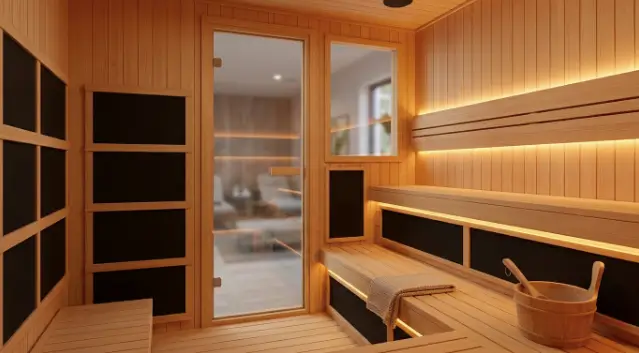
What an Infrared Sauna Really Costs, From Unit to Install
A one-person infrared sauna runs $1,800 to $2,800 for the cabin itself, with a two-person model landing between $2,400 and $3,800. Add delivery, and installation cost depends almost entirely on whether the existing electrical setup can support the cabin as-is. A plug-in unit on a standard 120-volt outlet can be running the same day it arrives, while a larger cabin needing a dedicated circuit adds $300 to $900 in electrical work before the first session.
What Does the Cabin Itself Cost by Size?
Sticker price scales with seat count and panel coverage more than with wood species. A one-person cabin from a mid-tier brand typically lists between $1,800 and $2,800. Two-person models run $2,400 to $3,800. Three-person cabins with L-shaped benches climb to $3,500 to $5,500, and four-person or full-spectrum builds with additional near-infrared emitters can reach $6,000 to $9,000. Entry-level imports undercut these ranges by a few hundred dollars but often use thinner panel arrays and shorter warranty terms, which shows up as uneven heat and higher failure rates within a few years.
| Cabin size | Typical unit cost | Electrical work needed |
|---|---|---|
| 1-person | $1,800 – $2,800 | Usually none (existing 120V outlet) |
| 2-person | $2,400 – $3,800 | Usually none (existing 120V outlet) |
| 3-person | $3,500 – $5,500 | Often a dedicated 20-amp circuit |
| 4-person / full-spectrum | $6,000 – $9,000 | Dedicated circuit or 240V, often required |
What Does Electrical Work Add to the Bill?
Most one and two-person cabins draw 1,500 watts or less on a standard 15 or 20-amp household circuit, which is the main reason they are popular for a quick bedroom, basement, or garage install without a contractor. Three-person and larger cabins, and any full-spectrum model with extra emitter zones, more often need a dedicated circuit run from the panel, which a licensed electrician typically prices between $300 and $900 depending on distance and whether the panel has spare capacity. Skipping this step and running a large cabin off a shared household circuit is a common cause of tripped breakers and, over time, of panels that never reach full output.
What Does Delivery and Setup Actually Involve?
Freight delivery for a prebuilt cabin typically runs $100 to $300 depending on distance from the distribution center, and most cabins ship flat-packed in two to four panels that bolt together in an hour or two with basic tools. Assembly is within reach for most buyers, though a second person makes leveling and squaring the panels considerably easier. Professional assembly, where offered, adds $150 to $400. Flooring underneath should be level and moisture-tolerant; a finished basement or tiled area works without modification, while a carpeted room may need a rigid pad to keep the cabin from settling unevenly over time.
Is a Full-Spectrum Panel Upgrade Worth Paying For?
Full-spectrum cabins add near-infrared and mid-infrared emitters to the standard far-infrared carbon or ceramic panels, usually for $500 to $1,500 more than a comparable far-infrared-only model. The upgrade buys faster warm-up and broader panel coverage, which some users prefer, but it is a comfort and convenience difference rather than a documented health advantage over standard far-infrared. Buyers on a tighter budget lose little by skipping the upgrade; buyers who plan to use the cabin daily and want a shorter warm-up window may find the added cost worthwhile.
See also: The Guy Everyone Trusted Just Disappeared. Here’s Who Actually Deserves It Now.
What Should You Budget for Ongoing Costs?
Electricity is the smallest recurring line item. A one-person cabin used once a day for 30 to 40 minutes typically adds $8 to $15 a month at average residential electricity rates, since infrared panels draw less power than a traditional heater raising an entire room to 180 degrees. The larger ongoing cost is component replacement after the warranty window closes, typically two to five years depending on the brand; a replacement panel or control board commonly runs $100 to $300. Interior wood, usually cedar or basswood, benefits from a light wipe-down after each session and an occasional conditioning treatment to prevent drying and cracking near the panels.
Should You Consider a Floor Model or Refurbished Unit?
Some retailers sell floor models, display units, or manufacturer-refurbished cabins at a discount of 15 to 30 percent off the standard price, which can be a legitimate way to lower cost on a mid-tier or premium cabin. The tradeoff is warranty coverage: a refurbished unit often carries a shorter warranty term than a new one, sometimes 6 to 12 months instead of the standard two to five years, and cosmetic wear on the exterior wood is common even when the panels and electrical components have been fully tested and reconditioned. Ask specifically what was tested and what the warranty covers before assuming a discounted unit is simply a new cabin at a lower price; in some cases the discount reflects real risk transferred to the buyer, and in others it genuinely is a sound way to get a full-price cabin’s performance for less.
New units from an established brand remain the safer default for a first-time buyer, since a full warranty and an undamaged exterior remove two of the more common sources of buyer’s remorse. A refurbished or floor-model purchase makes more sense for a buyer who has already owned a cabin before, knows roughly what to check, and is comfortable trading some warranty coverage for a lower upfront cost.
What Does the Research Say About Sauna Use and Cost-Justified Frequency?
Cost decisions often hinge on how often a cabin actually gets used, and the research on sauna frequency is worth factoring in. A 2023 review in Mayo Clinic Proceedings examined how sauna bathing combines with other lifestyle factors and found associations with cardiovascular outcomes strongest among more frequent users, generally several sessions a week. A companion paper in American Journal of Physiology – Regulatory, Integrative and Comparative Physiology reviewed the physiological effects of heat exposure with particular reference to Finnish sauna bathing. Both studies were built on traditional, higher-heat sauna use rather than infrared specifically, so the associations should be read as suggestive for infrared rather than a direct match. Given that, a cabin used three or more times a week justifies its cost far better than one that sits idle after the first month, which is worth being honest about before buying up to a bigger, pricier model. Current unit-by-unit pricing across sizes is visible at https://sweatdecks.com.
Frequently Asked Questions
How much does a one-person infrared sauna cost? A one-person cabin typically costs $1,800 to $2,800 for the unit. With delivery and a basic plug-in setup, total cost usually lands between $2,000 and $3,200.
Does an infrared sauna need an electrician to install? A one or two-person cabin on a standard 120-volt outlet usually does not. Larger cabins needing a dedicated 20-amp or 240-volt circuit typically require an electrician, adding $300 to $900.
Are full-spectrum infrared saunas worth the extra cost? Full-spectrum models add near and mid-infrared emitters for $500 to $1,500 more than far-infrared-only cabins. That buys faster warm-up and more coverage, not a proven health advantage.
What ongoing costs come with owning an infrared sauna? Electricity typically runs $8 to $15 a month for daily use. Budget for occasional panel or control-board replacement after the warranty period and periodic wood conditioning.
References
- Does the Combination of Finnish Sauna Bathing and Other Lifestyle Factors Confer Additional Health Benefits? A Review of the Evidence, Mayo Clinic Proceedings, 2023
- Effects of heat and cold on health, with special reference to Finnish sauna bathing, American Journal of Physiology – Regulatory, Integrative and Comparative Physiology, 2018
- Cardiovascular and Other Health Benefits of Sauna Bathing: A Review of the Evidence, Mayo Clinic Proceedings, 2018
By Grant Whitfield